
With our son’s adoption made official, we enjoy the best day ever
It felt like kismet that our judge once fought for PWS patients' treatment access
Written by |





Last week, my husband, Jamie, and I sat in a courtroom in Alleghany County, Pennsylvania, while our 1-year-old son, Ellis, bum-shuffled across the table in front of us. As we marveled at our little guy smiling and making faces, the court reporter and staff prepared for the hearing. Then we heard the words “All rise” as the judge entered the room. We stood.
This was it.
In January, we received an email from our adoption agency about a baby boy with a diagnosis of Prader-Willi syndrome (PWS). We had direct experience with the condition, because our 4-year-old daughter, Emerson, has the same diagnosis. We weren’t “seeking out” another placement with PWS, but we knew what we’d be getting into. We enthusiastically said yes to being considered.
The day had finally come. Nearly 10 months after receiving that email, we were surrounded by family, ready to finalize Ellis’ adoption.
A special day for the judge, too
Judge Hugh McGough opened the proceeding by telling us this was the highlight of his day. During testimony, we learned of his connection and familiarity with PWS when he took on a case years earlier to secure coverage for treatments that insurers frequently classified as “experimental” or “investigational.” His successful legal battle was an important one that ensured patients had insurance coverage and access to treatment.
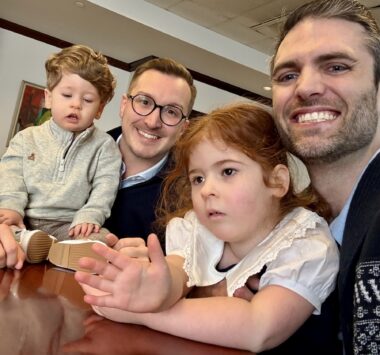
Ellis, 1, sits on a table with his fathers, Trevor and Jamie Dykes, and sister, Emerson, 4, ahead of his adoption finalization hearing. (Courtesy of Trevor Dykes)
The amazement and gratitude in the room were palpable. That this judge, who fought to secure access and coverage for treatment for people with PWS, was the one presiding over our hearing felt like kismet. I couldn’t stop from tearing up, and when he finished, I thanked him for sharing his connection to the PWS community and for all he’s done in support of progress.
Our family filled the room, some in person and some virtually. Ellis kept making faces at everyone in the room throughout the hearing, and Emerson kept taking off her shoes. When the judge made his final decree, making Ellis’ adoption official, excitement hit first, followed by a sense of relief. Ellis was already our son, and nothing about our days was changing.
What changed was the limbo we’d been living in.
Life in limbo
Ellis’ surgery in September is the clearest example. We knew his needs and we were the ones at his bedside, but before the surgery we needed approval from the agency that placed him. That’s how the process works while an adoption is pending.
We also had limited access to his MyChart through his healthcare system, so we were sometimes working from partial information. This included not being able to access his after-visit summaries. Coordinating his insurance took real effort. We also had monthly visits from our social worker (who is lovely and we adore), which was another appointment to juggle — in addition to therapies, specialists, and school schedules. None of that kept us from showing up for him, but every decision and action came with an extra step.
What Emerson taught us
We didn’t walk into this blind. Navigating the adoption process and the healthcare system was old hat, since we’d already done it with Emerson. She showed us how to navigate PWS, how to move through the healthcare system, and how to advocate when a plan doesn’t fit our kid, such as when we had to explain her diet and restrictions when she started early intervention preschool and all-day, clinic-based applied behavior analysis therapy.
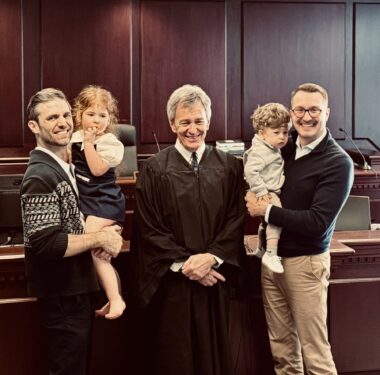
Judge Hugh McGough, center, stands with Jamie and Trevor Dykes and their children, Emerson, 4, and Ellis, 1, following Ellis’ adoption hearing. (Courtesy of Trevor Dykes)
Ellis arrived with his own needs, including low muscle tone and feeding difficulty, and the skills we built with Emerson carried over. His gastrostomy tube was new to us, but we’ve become quick learners. For most of the rest, it’s become second nature. Finalization didn’t give us new instincts. It gave us the authority to act on the ones we already had.
What changes now
While we wait for the official documentation to arrive, the decisions about his care are ours to make as his legal parents, without anyone else’s sign-off. That means full MyChart access, which is a relief all on its own. We’ve also decided our family is complete, so we’ve officially closed our journey of navigating the adoption process.
November is National Adoption Month, and it seems fitting that Ellis’ adoption became final in the first week of it. We’ve always been their biggest advocates. Now, in the eyes of the law, we are also both of their parents.
By the time evening came, the courtroom felt far away and things felt truly settled. After a long day of excitement and travel, we made it home and all of us curled up on the couch. It felt like any other evening, but also like the best evening ever.
Note: Prader-Willi Syndrome News is strictly a news and information website about the disease. It does not provide medical advice, diagnosis, or treatment. This content is not intended to be a substitute for professional medical advice, diagnosis, or treatment. Always seek the advice of your physician or other qualified health provider with any questions you may have regarding a medical condition. Never disregard professional medical advice or delay in seeking it because of something you have read on this website. The opinions expressed in this column are not those of Prader-Willi Syndrome News or its parent company, Bionews, and are intended to spark discussion about issues pertaining to Prader-Willi syndrome.

Leave a comment
Fill in the required fields to post. Your email address will not be published.